The threat of infection increased by as much as 30 percent approximately amongst individuals with observances in the very first 10 months of 2020
Anecdotally, casual celebrations such as vacation parties, celebrations and wedding events appear to have actually played a crucial function in spreading out the infection. There is no simple method to carefully check this hypothesis on a big scale. A brand-new research study released in JAMA Internal Medication navigates these troubles by evaluating the connection in between birthdays and COVID-19infection rates According to the findings, families that had a current birthday– and hence a higher probability of having actually tossed a celebration– in counties with a great deal of cases had about a30 percent greater danger of infection in the following 2 weeks, compared to homes that did not have a birthday. Those commemorating a kid’s birthday, the authors discovered, were at the greatest
danger of all.
.
” Everybody in the research study was amazed at how huge of a boost in danger this 30 percent appeared,” states lead author Christopher Whaley, a health policy scientist at the Rand Corporation, a not-for-profit research study group based in Santa Monica, Calif. “I believe this truly talks to where a great deal of infections originated from over the in 2015.”
While a handful of previous research studies took a look at the function that casual events played in unique coronavirus infections, they primarily concentrated on one-off occasions, such as a single wedding party in Maine Whaley and his coworkers recognized that birthdays might be an especially helpful tool for revealing nationwide COVID-19 transmission patterns for a variety of factors, consisting of the truth that everyone has one which they take place throughout the year.
The authors gotten nationally representative information for 2.9 million U.S. families from Castlight Health, a business that assists individuals browse the healthcare system. The information, which covered the very first 10 months of 2020, consisted of relative’ birthdays, in addition to any favorable COVID-19 test results they got through insurance coverage claims. While the scientists do not understand if individuals consisted of in their research study really had a birthday celebration, they assumed that birthdays might work as a proxy for the possibility that a celebration occurred.
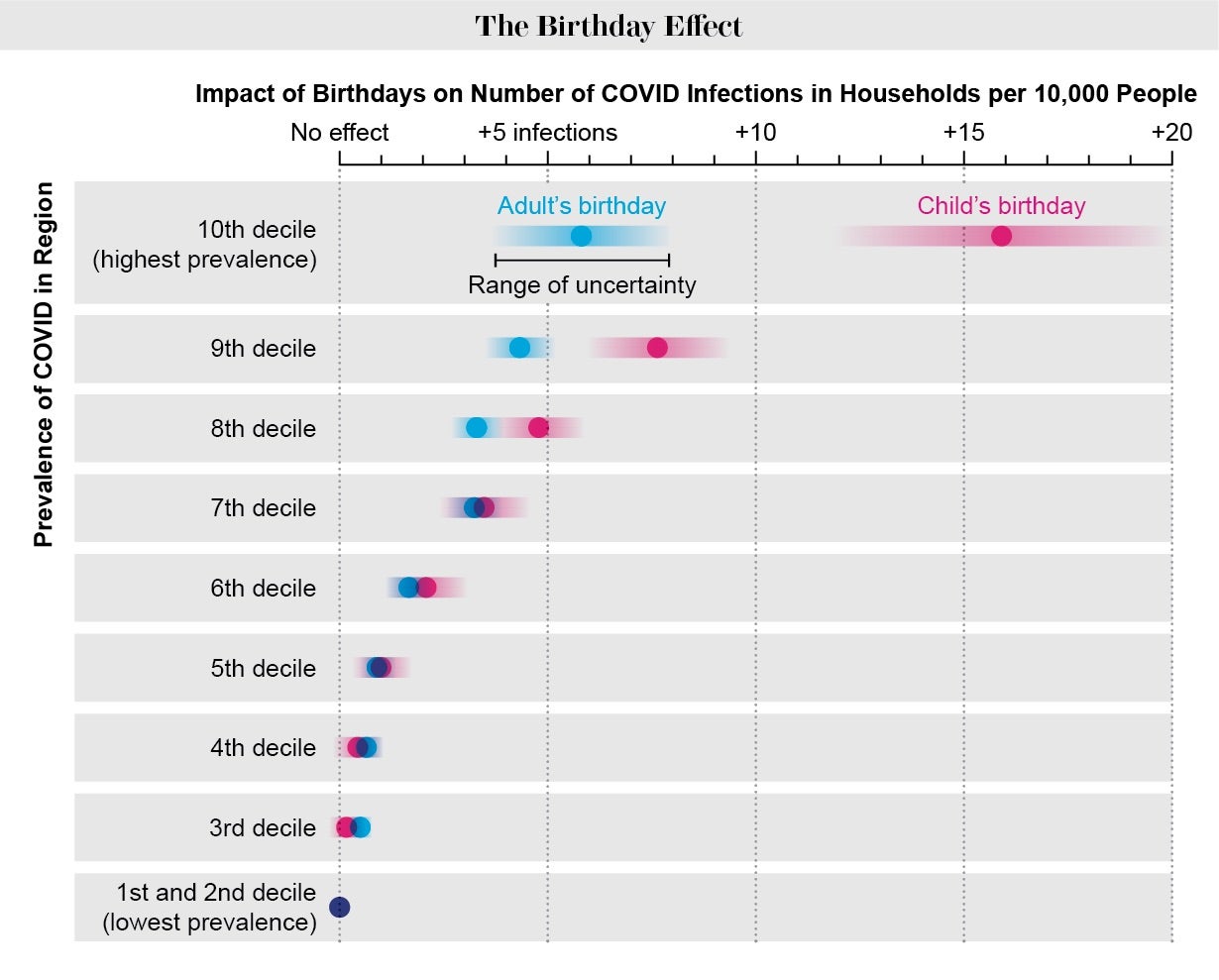
The findings exposed a considerable connection in between birthdays and increased COVID-19 transmission danger. In counties experiencing the greatest spread of the illness (the top decile), families with a birthday balanced 8.6 more cases per 10,000 people than others close by without birthdays. In locations with low frequency of the infection, birthday-correlated infections were likewise low. Tellingly, the findings were not affected by political leaning, as determined by how counties enacted the 2016 election. And they were not impacted by quarantine orders or the weather condition. Taken together, this indicate a more universal pattern of habits instead of something that was affected by extenuating scenarios, such as rain driving a celebration inside your home, or by families’ ideology. “If you’re collecting informally with friends and family, perhaps you’re most likely to let your guard down or not use a mask,” Whaley states. “Emotionally, perhaps you do not think about friends and family as having the exact same threat level as the public.”
Whaley and his associates were especially amazed to see the strong result that kids’s birthdays appeared to have on COVID-19 transmission threat. In counties with the greatest occurrence of the illness, a kid’s birthday brought more than double the danger of infection of a grownup’s birthday, with a boost of 15.8 additional COVID-19 cases per 10,000 individuals, compared to figures for individuals who did not have birthdays. While the scientists do not understand what represent the extra danger, Whaley assumes that maybe moms and dads are more reluctant to bypass a celebration for a kid even in the middle of a pandemic or that celebration participants at a kid’s birthday might be less disciplined about social distancing.
For both kids and grownups, however, the findings show just the typical impact of a birthday on COVID-19 danger, indicating they are probably an underestimate for those who did collect for events over the pandemic. If Whaley and his associates had actually had the ability to distinguish in between individuals who had a celebration and those that did not, for instance– or in between individuals tossing a celebration that did or did not use masks and social range at that event– the outcomes most likely would have been a lot more noticable.
However, the brand-new research study plainly verifies that “throughout a pandemic, it is fine to be a celebration pooper,” states Donald Redelmeier, a teacher of medication at the University of Toronto, who was not associated with the research study. “It is a huge recommendation, in retrospection, of the gains amongst those who avoided all sorts of celebrations– wedding events, birthday celebrations, you call it.”
ABOUT THE AUTHOR( S)

Rachel Nuwer is a self-employed reporter and author of Poached: Inside the Dark World of Wildlife Trafficking(Da Capo Press, 2018). She resides in Brooklyn, N.Y.
Follow Rachel Nuwer on Twitter
Credit: Nick Higgins




No comments:
Post a Comment