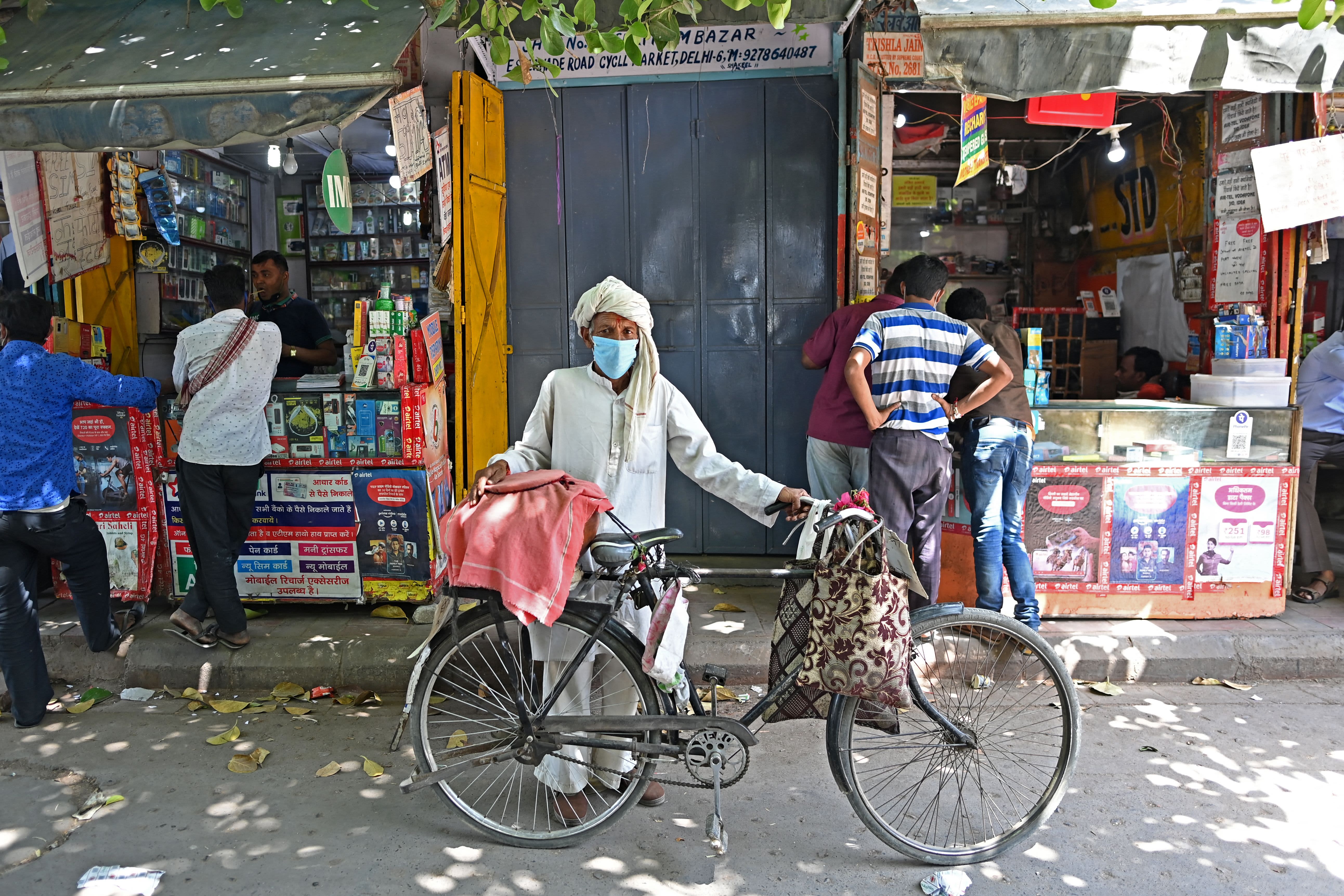
A guy with his bike on a street in the old quarters of New Delhi on April 19, 2021, as India’s capital will enforce a week-long lockdown from tonight, authorities stated, while the megacity has a hard time to consist of a substantial rise in Covid-19 cases with health centers lacking beds and oxygen materials low.
Sajjad Hussain|AFP|Getty Images
India crossed 20 million reported cases of Covid-19 on Tuesday.
There were 357,229 brand-new cases reported over a period of 24 hours, bringing the overall to 20.28 million, according to health ministry information.
India’s very first cases were found in late January in 2015 and the nation’s overall did not cross 10 million infections till December, according to Johns Hopkins University information. The next 10 million cases were reported in the period of simply under 5 months, mainly in April.
Up until now, a minimum of 222,408 individuals have actually passed away from the illness, however that number is likely lower than the real death toll. Media reports recommend crematoriums and burial premises are overwhelmed with bodies of those who passed away from Covid-19
” The pandemic has actually now gone into the towns and the towns, and we are now rather anxious about just how much of a destruction it will trigger in those locations where the health systems are not well established enough to offer assistance, when even a few of the huge cities are battling with the case load on health centers,” K. Srinath Reddy, president at the general public Health Structure of India informed CNBC’s “ Capital Connection” on Monday.
Some states are entering into lockdowns
Throughout the very first wave in 2015, India enforced a stringent nationwide lockdown in between late-March and Might, which hindered the nation’s development trajectory and left millions without an income source.
While the main federal government appears unwilling to enforce a 2nd across the country lockdown, a number of states have actually stepped up limitations in current weeks, consisting of regional lockdowns and curfews. That consists of Maharashtra, which is India’s worst-hit state, Delhi, West Bengal, Uttar Pradesh, Rajasthan, Karnataka and others.
Some health specialists have actually recommended that India requires a nationwide stay-at-home order and a medical emergency situation statement to attend to present health-care requirements.
India’s health-care system has actually been overwhelmed by the sharp increase in cases as it deals with a scarcity of health center beds, oxygen supply and medications to deal with clients.
Public Health Structure’s Reddy informed CNBC that India requires a two-pronged method to eliminate the 2nd wave. Efforts to immunize more than 1.3 billion individuals need to continue.
India deals with a minimum of near-term vaccine lacks and simply over 2%of the population has actually gotten both dosages. Beginning in May, India is opening vaccinations to anybody age 18 and older.
Second, India requires a “really strong” containment method to lower the spread.
We had actually turned our back on the infection, however the infection did not turn its back on us. And now we are paying the rate.
K. Srinath Reddy
president, Public Health Structure of India
” What we require to do right away is to lower the transmission from individual to individual, by making sure that there are no big crowds,” Reddy stated, including that India needs to not enable more than 4 individuals to collect in public locations and locations with high positivity rates need to be taken into complete containment mode.
He included that India requires to guarantee sufficient social assistance for individuals who are recuperating in the house from milder signs.
How did India get here?
India’s 2nd wave started a long time in February when cases began increasing once again. Prior to that the nation reported about 10,000 infections a day, usually. April saw a high spike in the curve, with almost 7 million reported cases.
The Indian federal government is dealing with criticism for letting big crowds collect for spiritual celebrations and election rallies previously this year. Those mass events most likely became very spreader occasions.
Researchers state the spike in cases is likewise partly due to variations of the coronavirus distributing in India at the minute. That consists of a regional version called B. 1.617 that has several sub-lineages with a little various particular anomalies.
Reddy described that in its desire to put the economy back on track, India neglected the looming hazard of a 2nd wave.
” I believe by early January when the day-to-day case counts, the day-to-day death counts and the test positivity rates plunged, extensive impression collected ground that we had actually ended the pandemic permanently,” he stated, including, “We had actually turned our back on the infection, however the infection did not turn its back on us. And now we are paying the rate.”




No comments:
Post a Comment